

AI agents for B2B lead generation automate the part of selling that takes the most time: finding the right company and the right person. Agents research companies that match your ideal customer profile from publicly available sources, score each prospect against shared criteria and hand it to the sales team with a personalized first-message draft. The decision to send stays with a person. For our clients across several industries, this setup increased the customer acquisition rate by about 70%.
Why now?
In B2B sales the problem is rarely “there are no customers”. It is that there is not enough time to find the right ones. A salesperson’s day often goes to building lists, reading websites one by one, finding the decision maker and writing a separate message for each. Most of that is repetitive research and writing.
Large language models (LLMs), and the AI agents built on them, can now do this kind of research and writing reliably. What makes the difference is not the model itself, but how well you design which sources the agent looks at, which criteria it decides by, and where it stops and asks a person.
How do customer-finding AI agents work?
In our projects we don’t give this job to one AI that “does everything”. We split it across several agents, each with a defined role:
- Targeting framework: The ideal customer profile is defined by industry, company size and need signals. The answer to “who do we sell to, and why would they choose us?” becomes rules for the agents.
- Research agent: Identifies companies matching the target profile, and the right contact by role and department, from publicly available sources.
- Qualification agent: Scores and prioritizes every prospect against shared criteria and hands it to sales with the reason it fits.
- Outreach agent: Drafts a personalized first message and follow-up based on each company’s actual situation, and manages the follow-up schedule.
- Control layer: Every message goes through human approval, opt-outs are processed automatically and the whole process is logged.
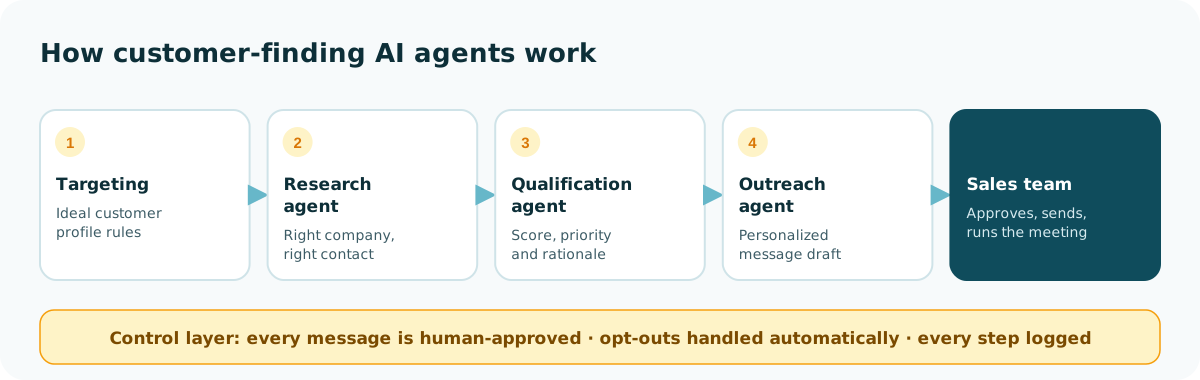
The split matters: when something goes wrong you can see exactly where, and each agent’s permissions stay limited to its own job.
What we learned from our project
In the lead generation system we built for B2B companies in different industries (full case study: AI agents that find new customers for sales teams):
- Customer acquisition rate increased by about 70%. The gain came not from sending more messages, but from sending better-timed messages to better-fit companies.
- The sales team stopped researching and started talking. The team now works with qualified prospects that arrive with a clear rationale.
- The same setup works across industries. What changes is the targeting rules and the tone of the messages; the architecture stays the same. That is why we now offer it as a ready-made product adapted to each company.
One of the things behind these results was human approval. It can look like a step that slows things down, but in the first weeks it showed exactly where the agent missed the tone, and let us improve the rules quickly.
Where does it go wrong?
Badly set up lead generation agents can damage a brand. The most common mistakes we see:
- The volume trap: “The agent works, so let’s send thousands of messages a day” leads to spam complaints, a damaged domain reputation and your emails landing in spam folders.
- Made-up personalization: A model can write as if it knows something about a company that it doesn’t. Every personal detail in a message must be backed by a source the agent actually found.
- Reaching the wrong person: The right company but the wrong department means wasted effort. Role and department criteria matter as much as company criteria.
- Starting without rules: If the ideal customer profile isn’t clear, the agent can’t choose clearly either. AI doesn’t fix poor targeting; it only speeds it up.
How do you stay compliant with GDPR, KVKK and e-marketing rules?
B2B lead generation still processes personal data: a contact’s name, job title and work email are covered by the GDPR in Europe and by KVKK in Türkiye. Commercial emails are also subject to e-marketing rules, which differ by country and are often stricter for consumers than for businesses. In every case, recipients must be given an easy way to opt out.
The principles we build in from the start:
- Use only business-related, publicly available company information; don’t collect data about people’s private lives.
- Keep data to a minimum: Don’t store information the agent doesn’t need to make its decision.
- Include an opt-out in every message, and remove a person from the list immediately when they ask.
- Keep records: Where each piece of data came from and when each message was sent should be traceable.
These are general principles; we recommend confirming your specific industry and target markets with your legal advisor. For the broader picture, see our guide to GDPR and KVKK compliant AI.
How do you measure success?
The number of messages sent is not a success metric. The indicators we recommend tracking:
| Metric | What it tells you |
|---|---|
| Qualified prospect rate | How many of the agent’s prospects the sales team actually considers a fit |
| Positive reply rate | How many messages lead to interest or a conversation |
| Meeting conversion rate | How many replies turn into meetings |
| Sales time per prospect | How much research time the team has saved |
| Opt-out and complaint rate | Whether targeting and tone are right |
Measure the current value of these metrics before you start; otherwise you can’t prove the improvement.
Where to start
- Write down your ideal customer profile: Which industry and size were your best customers last year, and why did they choose you?
- Start with a narrow pilot: Pick one industry or region and work with a limited number of prospects per week.
- Keep human approval on: Read every message in the first weeks, and use that feedback to improve the agent’s rules.
- Measure, then expand: Move to new industries and higher volume once the metrics improve.
How BrotherhoodIO approaches it
We build lead generation agents as part of our AI agents & process automation service, as a ready-made product that works across industries: we adapt the targeting rules to your sales strategy, build in human approval and opt-out handling from day one, and report results against measurable metrics. We are vendor-neutral and choose the best model for each task.
To see where lead generation agents could make a difference in your sales process, book a free 30-minute AI Assessment.
Author
Yusuf Öztürk Co-Founder, BrotherhoodIO
Co-founder of BrotherhoodIO, with more than 10 years of experience in the software industry. Today he builds AI agents, enterprise AI assistants and process automation systems for companies.
Frequently asked questions
Will AI agents replace the sales team?
No. Agents take over repetitive work such as research, pre-qualification and first-draft messages; conversations, proposals and relationships stay with the sales team. Set up well, the team spends its time talking to qualified prospects instead of researching.
Doesn't AI lead generation turn into spam?
It can if it runs without control. That is why every prospect should be scored against shared criteria, every message approved by a person before sending, volume capped, and opt-out requests processed immediately.
Can B2B lead generation agents be GDPR and KVKK compliant?
Yes, if they are designed for it from the start: use only business-related, publicly available company information, keep data to a minimum, offer an easy opt-out and keep records. We recommend confirming your specific situation with your legal advisor.
How long does it take to get such a system running?
It depends on scope. In our own project the first version went live in two months; today we adapt the same setup to new companies as a ready-made product in much less time.